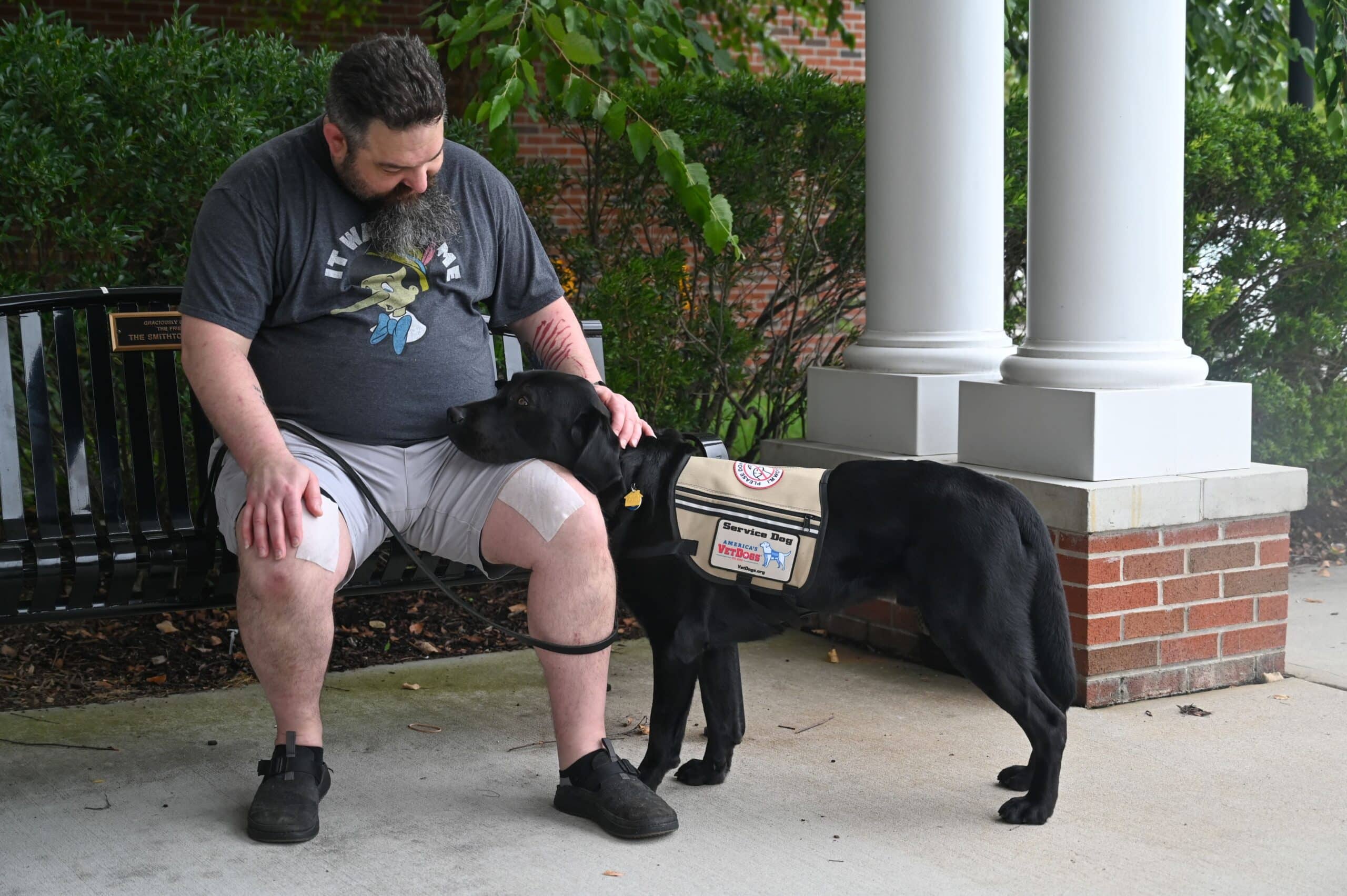
Mae Philanthropies Grant Adds Key Support to DU Research on Veterans and Service Dogs
A recent grant from Mae Philanthropies has completed the funding for a University of Denver Graduate School of Social Work Institute for Human-Animal Connection (IHAC) study on how service dogs affect veterans living with posttraumatic stress disorder (PTSD). The study seeks to provide new insights into treatment, recovery, and well-being for veterans and their service dogs.
When a scientific study reaches full funding, it signals confidence in the science, the research team, and the potential impact of the work. A recent grant from Mae Philanthropies provided IHAC with this final boost. The funding completed support for this four-year study, which explores the psychological and physiological effects of psychiatric service dog partnerships with veterans experiencing PTSD. Already underway, the study is among the first to investigate these partnerships through molecular physiology, examining changes experienced by veterans and their dogs.
Philanthropic Investment
Mae Philanthropies is committed to enriching lives one paw and one step at a time. Through its Pawsitive Impact initiative, Mae Philanthropies funds rigorous, evidence-based research on the transformative impact of the human-dog bond, with an interest in canine-assisted recovery and mental health treatment modalities. At the heart of Pawsitive Impact is the simple truth that dogs change lives. Together with strategic partners like IHAC, Mae Philanthropies seeks to spark innovation, inform new solutions, and drive impactful science-based change.
The Mae Philanthropies grant builds on earlier support from the Morris Animal Foundation, SomaLogic, the Human-Animal Bond Research Institute, the William and Charlotte Parks Foundation, and the William E. Dean III Charitable Foundation, along with other donors who share a commitment to early investment in this type of innovative, science-driven research.
Study Design
While prior research has shown that psychiatric service dogs can be beneficial for veterans with PTSD, the IHAC study is examining how those partnerships affect the body and which biological pathways are involved. As part of the study, IHAC is partnering with SomaLogic, a biotechnology company based in Boulder, Colorado, whose proteomics platform measures approximately 11,000 proteins from a single blood sample. The samples are collected from participating veterans and their service dogs at multiple points before and after pairing. This strategy enables researchers to track changes in protein concentrations over time and correlate those shifts with clinical and behavioral data.
Research Professor, IHAC Executive Director, and American Humane Endowed Chair Kevin Morris, PhD, says, “What sets our study apart is the depth of the biological analysis and its dual focus. While most research in this area examines outcomes for veterans, we are also studying how service dog work affects the dogs themselves, including behavior and physiology. Understanding both sides of the partnership is essential for the welfare of the dogs, as well as for understanding how these relationships function as a system.”
Early Findings
Researchers have begun generating early results through a pilot analysis with SomaLogic by extracting blood samples and data from 10 veteran-dog pairs during the first several months of their partnerships. Early results show decreases in PTSD symptom severity among participating veterans. Additionally, preliminary behavioral data suggests the dogs experience no negative effects. Moving forward, the research team will begin a deeper analysis of the data to explore how changes at the molecular level correspond with the observed outcomes.
Coordinated Effort
At DU, work with veterans and their families is part of a unique, integrated, cross-departmental model that brings mental health care, legal advocacy, and innovative, evidence-based research and evaluation into a single coordinated network. This range of support for veterans and their families enables behavioral health, wellness, and legal stability to be addressed simultaneously, creating more durable and meaningful outcomes. Within this collaboration, IHAC brings experiential and animal-assisted interventions that complement and inform clinical and community-based care.
Graduate School of Social Work Dean Henrika McCoy, PhD, says, “Kevin’s leadership of this study highlights not only the transformative power of the human-animal bond but also DU and GSSW’s commitment to tackling complex societal challenges through innovative, interdisciplinary approaches.”
Looking Ahead
As the study moves forward, researchers will continue collecting and analyzing data, generating insights that extend across the DU continuum of care and beyond, and strengthening overall understanding of the challenges faced by veterans with PTSD. By producing rigorous biomedical evidence, this study has the potential to inform future treatment approaches for veterans and others, guide policy and funding decisions, and deepen the understanding of the human-animal bond.
“This research reflects the true spirit of The Denver Difference — it brings together expertise across disciplines to address complex challenges facing veterans and their families,” says Val Otten, senior vice chancellor for Advancement. “Philanthropic partners are drawn to DU because collaboration is not an add-on here; it’s how meaningful progress happens. This study is one example of how that shared commitment creates outcomes that serve the greater good.”
To learn more about how a gift to the Institute for Human-Animal Connection can strengthen the Institute’s work, contact Ashley Haliko at ashley.haliko@du.edu or 303-871-2675.
Read more about IHAC:
